Afterword

ThimphuTech was the first technology blog in Bhutan. We started writing it in 2009, just as broadband and mobile internet started to take off. (Although internet in Bhutan was launched in 1999, it was either super-slow or super-expensive, and was only used by a selected few).

In the blog, we wrote about technology and food, but also about plenty of other stuff. The blog became popular and influential in Bhutan. A companion bi-weekly column -- Ask Boaz -- was published for many years in the Kuensel, Bhutan's national newspaper. (The complete Kuensel columns are available as an ebook, Blogging with Dragons).

We stopped updating the blog when we left Bhutan in 2014, but the information within the posts can still prove useful, and thus we decided to keep it online.

We thank all our readers.
Tashi Delek,
Boaz & Galit.

Saturday, March 2, 2013

Roaming in Bhutan (K2 #57)

Question of the Week
I will be volunteering in Bhutan in the spring. Will I be able to use my Samsung Galaxy S II phone there? Do I need to get a local SIM or can I use my Vodafone SIM?
— Emma, New Zealand

Answer
Before travelling to Bhutan, make sure that your phone’s hardware is compatible: In your case, Samsung Galaxy S II supports all four major GSM frequencies (850, 900, 1800 and 1900 MHz), and these cover the GSM frequencies used in Bhutan (900 and 1800 MHz). Cheers!

To keep using your New Zealand number, check if your mobile operator has a roaming agreement with a Bhutanese mobile operator. Roaming will enable you to keep making and receiving calls using your local NZ number. Information about roaming is available on your operator’s website. I checked the Vodafone website, and they have a roaming agreement with TashiCell, one of Bhutan’s two operators. This means that whenever you are in a TashiCell-covered area, you will be able to make and accept calls using your NZ number.
Mobile counters at Paro airport?

I recently visited Sri Lanka. Getting a local SIM was a snap: all the major mobile operators have shrewdly set up friendly counters in the Colombo airport arrival hall, staffed with efficient representatives who quickly arrange everything, including taking your passport photo. Within 10 minutes and a wallet lighter by the equivalent of Nu. 150, I was all set with a prepaid SIM, which included 100 mobile minutes, 200 SMSs, and 1GB of 3G data. Unfortunately, a similar service is not (yet?) available at Paro airport.

The downside of roaming is that the rates of making and receiving calls - even local calls in Bhutan - as well as SMSing and using data, are absurdly expensive. Vodafone, for example, charges up to NZ$6 per minute. Upon returning home, roaming users often experience an unpleasant shock when receiving their mobile bill.

The alternative to roaming is buying a local SIM with a Bhutanese number. Just make sure that your phone is unlocked, which means it can work with any SIM, not only your Vodafone SIM. With an unlocked phone, simply remove your Vodafone SIM and insert the local SIM. Your sponsor in Bhutan can help you get a local SIM, or you can visit a B-Mobile or TashiCell office. Both operators have coverage in all of Bhutan’s 20 districts. SIMs are dirt-cheap and calling rates are low. A local minute to anywhere in Bhutan will cost you less than NZ$0.10, while calls back home to the land of kiwis will set you back around NZ$0.40 per minute.

Enjoy your visit to the Kingdom!

Readers are encouraged to submit technology-related questions to boaz@thimphutech.com

Thursday, February 28, 2013

4G coming to Bhutan

While Bhutan Telecom recently launched 3G in Bajo town, making it the fourth locality with mobile broadband (the others being Thimphu, Paro, and Phuentsholing), this announcement was made yesterday at the Mobile World Congress 2013, held in Barcelona:
European telecom equipment maker Ericsson said on Wednesday that it will deploy the 4G (LTE) network for Bhutan Telecom (BT) this year and pilot commercial services will be initially launched in the country’s capital Thimphu... As part of the 4G deployment, Ericsson will provide Bhutan Telecom with LTE equipment in the 1800 MHz spectrum band
4G (Fourth Generation) LTE (Long Term Evolution) is a mobile broadband technology with a theoretical peak download speeds of 300Mbps. Actual speeds will be lower, but have the potential to be an order-of-magnitude faster than 3G. Such speeds enable super-fast browsing and downloading as well as smooth video calls. Taking advantage of these technologies requires smartphones with LTE support at the right frequency (1800 MHz). Most, if not all, existing mobile phones and data-cards in Bhutan will not support the new standard, and will need to be replaced in order to use BT's upcoming 4G service. 2G and 3G will still be offered alongside the new technology.

Monday, February 18, 2013

Why @drukair must not display its poll results

Drukair is conducting a customer satisfaction poll on its website's homepage. A good idea, no doubt.

However, is it a good idea to display the results? Probably not, given the large number of Poor and Very poor ratings.

I would recommend:

  1. Finding out why so many people are not happy with Drukair
  2. Making sure visitors to the site will not be able to the the results.

Saturday, February 9, 2013

Managing Facebook (K2 #56)

Question of the Week
My Facebook page is packed with so many photos of cats from some of my friends. Is there a way to prevent these photos but without unfriending my friends?
— Tsewang D., Paro

Answer
Dear Tsewang,
*
 
*
Facebook tries to put the most interesting, relevant, or important posts from your friends at the top of your Facebook News Feed, but obviously their system is not perfect. The News Feed can quickly become overwhelming with tons of cat photos, baby photos, or the latest status updates from MBK mall in Bangkok...

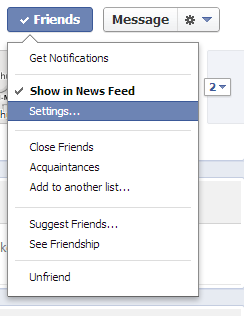
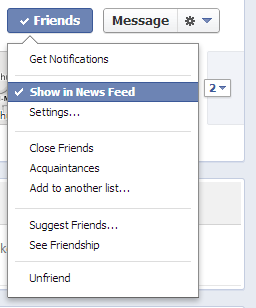
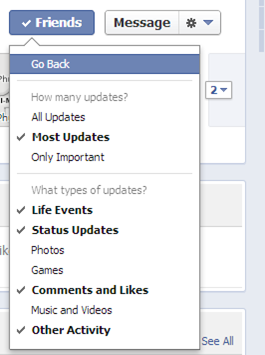
Luckily, Facebook has options to control the amount and type of information that lands in your News Feed, without the need to unfriend your cat-adoring acquaintances. The easiest option is to completely hide a friend from your News Feed. It’s easy to do: Just go to the friend’s page, click on the Friends button on the top-right (the button with the check mark), and a menu will pop up with a “Show in News Feed” option. If you uncheck this option, you will stop seeing any posts from this friend in your News Feed. Don’t worry - your unsuspecting friend will not be aware of that! Alternatively, you can fine-tune the information you see from your friend. Just click on the Settings option (below the “Show in News Feed” option), and a second menu will pop up. This sub-menu will allow you to decide how often you want to see posts from this friend (All Updates, Most Updates, Only Important), and which types of posts (Life Events, Status Updates, Photos, and more). One small shortcut: Instead of going to your friend’s page, you can also hover the mouse cursor above a friend’s name in your News Feed and wait a second or two for the menu to pop up.


Readers are encouraged to submit technology-related questions to boaz@thimphutech.com

Tuesday, January 29, 2013

Good news for smartphone users

Someone at B-Mobile must be reading our blog. Last week we pleaded for reducing the mobile Internet rates for smartphone users. The good news: Starting February 1, the pay-per-use rate for prepaid & postpaid users will be reduced by a factor of 10. The previous rate was Nu 0.003 / KB, which translates to Nu 3150 per GB. The new rate is Nu 0.0003 / KB, which amounts to Nu 315 per GB.

What does this mean? While the pay-per-use rate is still 50% more expensive than postpaid data plans, surfing the Internet using a phone - prepaid or postpaid - has become affordable. A significant step in the right direction.

Saturday, January 26, 2013

Getting alerts (K2 #55)

Question of the Week
I noticed that one of my Facebook friends is always the first to find and post links to interesting news and articles about Bhutan. How does she do that? Is she constantly using Google to find the new content?
— Raj K. in Thimphu

Answer
Dear Raj,

No, there is no need to keep searching the web. Let me reveal the secret: Google Alerts. This free service by Google allows subscribers to get an email whenever new content that matches predefined keywords becomes available on the web.

Google Alerts is very easy to use. Go to alerts.google.com, enter the keywords (for example, climate change, bhutan, lionel messi, or gross national happiness), select what kind of results you are interested in (news articles, blog posts, and more), how often you would like to be notified (instantly, once a day, or once a week), and how many results you want to handle (only the best, or all results). Finally, click Create Alert. That’s it. From now on, you will receive an email when newly-created web content matches the criteria. You can create up to 1000 alerts, and manage these alerts using the Manage your alerts button.

Better 3G Reception

Bhutan Telecom recently changed the frequency used for their 3G service from 2100 MHz to 850 MHz. The lower the frequency, the better a signal can penetrate through obstacles. In an urban environment, where there are buildings and walls, 850 MHz has better coverage than 2100 MHz. We can expect better reception and higher data rates following this shift.

When buying a smartphone or data card, it’s a good idea to check whether it supports multiple frequencies (also known as bands). The four most common frequencies are 850, 900, 1900, and 2100 MHz. A quad-band phone is one that supports all four frequencies, and will thus work almost anywhere in the world.

Readers are encouraged to submit technology-related questions to boaz@thimphutech.com
Thursday, January 17, 2013

It's Time for Prepaid 3G Plans

Mobile prepaid subscribers who use their phones to access the internet have to pay exuberant fees when using their phone to surf the web, send email, or stream videos. B-Mobile, for example, charges Nu 3000 per GB for their "pay as you go" plan - the only one available to prepaid phone subscribers.

With the improvement in Bhutan Telecom's 3G services, it is now time to move on to the next logical step: offering affordable prepaid 3G plans to mobile users. Currently, 3G plans are available for postpaid data-cards only, costing between Nu 200 to Nu 300 per GB, depending on the plan. These rates should also be available to smartphone users. For many users, these 3G prepaid plans will be their gateway to the Internet, thereby helping to narrow the growing broadband gap.

P.S.: With 3G prepaid plans, many subscribers will also find that carrying a data-card becomes unnecessary, as many smartphones can be tethered to a laptop, acting as de-facto data-card. This will reduce the number of mobile devices, which can help reduce the load on the mobile networks.