Question of the Week
I bought the Galaxy Grand Duos smartphone but found out that it does not work in Bhutan. What can I do? Will it help if I “root” the device?
— Samten Dhendup, Sr. Survey Engineer, NLC
Answer
The Galaxy Grand Duos model that is sold in India supports the 3G bands of 900, 1900, and 2100. The bands used for 3G by Bhutan’s operators are 850 and 2100. Thus, wherever 850 is used (Thimphu, Paro and a few other locations), your phone will not be able to use 3G. This is a limitation of the phone’s hardware, and “rooting” the phone – which means gaining complete control of the smartphone’s software – will not help. In fact, it often means voiding the manufacturer's warranty as well as running others risks, including making the phone totally unusable. Due to BICMA’s user-unfriendly decision to use the North American band of 850 instead of the standard Asian 900 band, quite a few other Bhutanese customers are in your situation and will need to buy new, expensive phones; if it’s any consolation, they say shared sorrow is half a sorrow.
Question of the Week
Is the Sherig Collection available online? How can I download it?
— Yeshi Choden
Answer
The Sherig Collection is a set of educational resources for teachers and students in Bhutan. It includes offline Wikipedia, thousands of educational videos, Dzongkha dictionaries, e-books, audio books, exam banks and more. It can be installed on any Windows computer - no Internet required. The size of the collection is pretty big - it’s about 25 GB, and it is not available online. Why? Given the speed and stability of broadband Internet in Bhutan, it would take days to download the Collection (assuming that the connection or the power did not drop half way, in which case you’d have to start all over again…). The only practical way to get the software is by copying it using an external hard drive or a 32 GB pen drive. You can get the software in many schools in Bhutan. For more information, register at sherig.rigsum-it.com.
With the new school year starting soon, let me take the opportunity and wish all teachers, students and parents a happy year of learning!
Readers are encouraged to submit technology-related questions to boaz@thimphutech.com
Showing posts with label Education. Show all posts
Showing posts with label Education. Show all posts
Saturday, February 15, 2014

Saturday, December 7, 2013
The Hour of Code (K2 #76)
Question of the Week
I want to learn programming in C++ and do not have any previous knowledge of other programming languages. What do you suggest?
— Mukul Dixit, Thimphu
Answer
Dear Mukul,
Learning a programming language - also known as coding - is not only fun, but an important skill. More than a way to land a high-end IT job or make a living writing mobile apps, it also provides many high-level cognitive benefits. Learning to code improves mental faculties, including problem solving, planning, and abstraction skills. It’s not surprising that more and more education systems around the world now include coding as part of their core school curriculum, often starting at primary school.
Now, C++ is probably not the first language you want to pick up as it’s more difficult to master. My suggestion is to start with a friendlier language that’s easier to learn. Once you are fluent in that and understand basic programming concepts, move on to C++. There are many good resources on the Internet; check the website code.org for good starting links. Two of the languages, Scratch and Python, would serve as gentler introductions to coding. Scratch is very easy to learn and a lot of fun. It uses visual programming - you simply drag-and-drop blocks to create simple animations, games and other programs. You can download the software at scratch.mit.edu. It is designed mainly for children, but there’s no reason why it cannot be used by adults as well. Scratch is best suited for educational purposes and not for real-world programming. Python, however, is a powerful, high-level language. It is one of the most popular languages in use these days, and Python programmers are much in demand. See the official website python.org for more information; there’s a tutorial under the Documentation tab.
Coincidently, next week (December 9-15, 2013) is “Computer Science Education Week”, organized by Code.org. Thousands of events in more than 160 countries are organized to teach people how to code, all under the theme “The Hour of Code 2013”. You can find more information about this huge event at csedweek.org.
Readers are encouraged to submit technology-related questions to boaz@thimphutech.com
I want to learn programming in C++ and do not have any previous knowledge of other programming languages. What do you suggest?
— Mukul Dixit, Thimphu
Answer
Dear Mukul,
Learning a programming language - also known as coding - is not only fun, but an important skill. More than a way to land a high-end IT job or make a living writing mobile apps, it also provides many high-level cognitive benefits. Learning to code improves mental faculties, including problem solving, planning, and abstraction skills. It’s not surprising that more and more education systems around the world now include coding as part of their core school curriculum, often starting at primary school.
|
Coincidently, next week (December 9-15, 2013) is “Computer Science Education Week”, organized by Code.org. Thousands of events in more than 160 countries are organized to teach people how to code, all under the theme “The Hour of Code 2013”. You can find more information about this huge event at csedweek.org.
Readers are encouraged to submit technology-related questions to boaz@thimphutech.com
Tuesday, May 14, 2013
Rigsum #SherigCollection visits Bajothang Book Fair
We just returned from two days at the Bajothang HSS book fair, where we displayed and distributed the Rigsum Sherig Collection to many schools outside of Thimphu: School principals, librarians, teachers and staff from nine dzongkhags visited the Rigsum Sherig Collection tent: Chhukha, Dagana, Gasa, Paro, Punakha, Thimphu, Trongsa, Tsirang, and Wangdue.
Teachers were eager to gain access to quality offline learning resources. Many have told us that the Internet connection at their school was more in theory than in practice (we learned that in some areas, 3am-6am was the only time to attempt sending an email!). Other schools were so remote that even mobile reception was insufficient. For teachers and students in such schools, the Sherig Collection was perceived as a life-changer. At last, teachers and students will have fast access to digital encyclopedias that do not cost a fortune and do not need to be kept locked behind glass doors. More than 2,000 Khan Academy videos in maths and sciences will provide teachers with new ways of teaching existing materials, and for students, ways to strengthen their knowledge and expand it, while keeping their curiosity healthy.
Nearly all schools that visited our tent reported having computers for students to access. While a few schools have only 1-2 computers for students, many others have a computer lab. School computers range from old models to newer ones, from those with Windows XP to those with Windows 7. Some visitors were surprised to learn that the Sherig Collection will work on even old computers running Windows XP.
Many of the teachers and principals who visited had an external hard-drive or a laptop with them. They were therefore able to copy the Sherig Collection (approximately 25–30 min), and take it back to their schools. The demand was so high, that at some point we had 4 or 5 disks attached to our computers at the same time!
An additional benefit is that these Sherig-Collection-holding-schools now serve as contact points for nearby schools. For example, the principal of Gasa Primary School, Mr. Pema Dorji, will be distributing the software to all four schools in Gasa. Mr. Passang Tshering at Bajothang HSS has been distributing the Sherig Collection to many schools in the Wangdue-Punakha area, as well as assisting fellow teachers with ideas and tips about using the collection.
Our display was also visited by several officers from the Ministry of Education's Department of Curriculum Research and Development. They too now have the collection and will serve as a distribution point for schools in Paro. Executive director of the Bhutan Canada Foundation along with a Canadian teacher have expressed much interest - we hope that they can help spread the collection to schools with BCF teachers.
The Sherig Collection can be used in many ways. Students can be instructed to conduct research on a particular topic during the weekly IT session. A staff room computer can help teachers improve their lesson plans. One of the early adopting teachers of the Sherig Collection shared that he uses a projector to show students a Khan Academy video during class.
It was a busy two days, with plenty of visitors, demos, downloading, and interactions. We have also collected wish lists for further improving the collection.
Educators who missed the Bajo fair and the earlier information session in Thimphu are welcome to visit us at the Rigsum Research Lab and obtain the collection.
The Sherig Collection Facebook group, intended for sharing information and experiences, already has over 100 members, including teachers, principals and other education/knowledge seekers. The group is fairly active and we invite teachers, librarians, principals, curriculum developers and anyone interested in getting their school or organization on board.


We extend our many thanks to Bajo teacher Mr. Passang Tshering for organizing the Sherig tent and for the wonderful hospitality.
 |
| Teacher from remote Lungtengang PS downloads the collection |
 |
| Lots of interest from principals, teachers, and students |
Teachers were eager to gain access to quality offline learning resources. Many have told us that the Internet connection at their school was more in theory than in practice (we learned that in some areas, 3am-6am was the only time to attempt sending an email!). Other schools were so remote that even mobile reception was insufficient. For teachers and students in such schools, the Sherig Collection was perceived as a life-changer. At last, teachers and students will have fast access to digital encyclopedias that do not cost a fortune and do not need to be kept locked behind glass doors. More than 2,000 Khan Academy videos in maths and sciences will provide teachers with new ways of teaching existing materials, and for students, ways to strengthen their knowledge and expand it, while keeping their curiosity healthy.
Nearly all schools that visited our tent reported having computers for students to access. While a few schools have only 1-2 computers for students, many others have a computer lab. School computers range from old models to newer ones, from those with Windows XP to those with Windows 7. Some visitors were surprised to learn that the Sherig Collection will work on even old computers running Windows XP.
Many of the teachers and principals who visited had an external hard-drive or a laptop with them. They were therefore able to copy the Sherig Collection (approximately 25–30 min), and take it back to their schools. The demand was so high, that at some point we had 4 or 5 disks attached to our computers at the same time!
 |
| Gasa PS principal (left) and Bajo HSS IT teacher (middle) |
Our display was also visited by several officers from the Ministry of Education's Department of Curriculum Research and Development. They too now have the collection and will serve as a distribution point for schools in Paro. Executive director of the Bhutan Canada Foundation along with a Canadian teacher have expressed much interest - we hope that they can help spread the collection to schools with BCF teachers.
The Sherig Collection can be used in many ways. Students can be instructed to conduct research on a particular topic during the weekly IT session. A staff room computer can help teachers improve their lesson plans. One of the early adopting teachers of the Sherig Collection shared that he uses a projector to show students a Khan Academy video during class.
 |
| DCRD Director getting a tour of the Sherig Collection |
It was a busy two days, with plenty of visitors, demos, downloading, and interactions. We have also collected wish lists for further improving the collection.
Educators who missed the Bajo fair and the earlier information session in Thimphu are welcome to visit us at the Rigsum Research Lab and obtain the collection.
The Sherig Collection Facebook group, intended for sharing information and experiences, already has over 100 members, including teachers, principals and other education/knowledge seekers. The group is fairly active and we invite teachers, librarians, principals, curriculum developers and anyone interested in getting their school or organization on board.

We extend our many thanks to Bajo teacher Mr. Passang Tshering for organizing the Sherig tent and for the wonderful hospitality.
Friday, March 9, 2012
Free Web education: now more practical in Bhutan

Wednesday, March 7, 2012
Bookless in Bhutan

Friday, October 21, 2011
Online course "Interactive Data Visualization" (Opens next Friday)
I'll be instructing an online course on Interactive Data Visualization, starting Oct 28.
This course is about the interactive exploration of data, and how it is achieved using state-of-the-art data visualization software. Participants will learn to explore a range of different data types and structures. They will learn about various interactive techniques for manipulating and examining the data and producing effective visualizations.
This is very practical and hands-on course. We use real data and discuss practical issues.
This is also a great opportunity to interact with professionals worldwide (through an online discussion board) and to take advantage of online learning for expanding your knowledge. The course is completely asynchronous -- not need to be online at a certain time.
Who can benefit from this course? managers, journalists, researchers and others who handle and present data. Feel free to email me for more information and for the special terms for Drukpas.
This course is about the interactive exploration of data, and how it is achieved using state-of-the-art data visualization software. Participants will learn to explore a range of different data types and structures. They will learn about various interactive techniques for manipulating and examining the data and producing effective visualizations.
This is very practical and hands-on course. We use real data and discuss practical issues.
This is also a great opportunity to interact with professionals worldwide (through an online discussion board) and to take advantage of online learning for expanding your knowledge. The course is completely asynchronous -- not need to be online at a certain time.
Who can benefit from this course? managers, journalists, researchers and others who handle and present data. Feel free to email me for more information and for the special terms for Drukpas.
Wednesday, August 17, 2011
Broadband for education

This is just one incredible example of the learning opportunities created by the Web. For small, isolated countries with limited educational resources like Bhutan, distance learning holds an incredible promise. If not for any other reason, the government of Bhutan should make fast, cheap and reliable broadband, including 3G for remote areas, a top priority.
Saturday, May 21, 2011
Tech news roundup
ThimphuTech's take on technology news from Bhutan's leading news sources.
 Headline: High Speed Internet (18/5/2011)
Summary: Now that almost 100% of gewogs in Bhutan have cellular coverage, focus is shifted to closing the broadband digital divide.
Our take: A fibre optic network providing high-speed Internet to all gewogs has enormous potential, from distance learning to tele-medicine. It can also enable IT-based businesses in remote areas helping to mitigate rural-urban migration. The question is, as always, how will the technology be used. Will the to-be-established community centres be used as learning centres, communication centres, or will they turn into video-game/Facebook parlours/?
 Headline: BICMA facilities better internet services (21/5/2011)
Summary: Software offered by LIRNEasia that will measure your Internet connection's performance is available for free download at www.broadbandasia.info. Note: It was not easy to summarize this article, which has a rather misleading headline and some confusing technical information (e.g., the "speed of the internet" is not "300 millisecond return trip time")
Our take: With more and more users complaining about BT's internet speed, this is a good initiative. But what is one supposed to do with the test results? Feel free to share them with us!
 Headline: BlackBerry refuses Bhutan (21/5/2011)
Summary: Research in Motion (RIM), the manufacturer of the BlackBerry smartphone, is not going to install a BlackBerry server in Bhutan.
Our take: One can understand the business logic behind the decision by RIM, but this is bad news for the few locals who own the device - known also as the CrackBerry due to its addictive nature - and will not be able to use its more advanced features. BlackBerry-addicted visitors to Bhutan will also be disappointed.
Bonus: Jerry Sienfeld and the BlackBerry.
Headline: Pills for piracy (21/5/2011)
Summary: In an attempt to combat software piracy in Bhutan, an effort will be made to offer Microsoft products (especially MS Office) at reduced prices.
Our take: Good initiative! However, this will require more than a monetary discount. It is also about a change of mindset. But equally important: Why doesn't Microsoft provide free or almost-free software for schools, colleges and other educational and academic institutes in Bhutan, in the same way it does in other countries?
 Headline: High Speed Internet (18/5/2011)
Summary: Now that almost 100% of gewogs in Bhutan have cellular coverage, focus is shifted to closing the broadband digital divide.
Our take: A fibre optic network providing high-speed Internet to all gewogs has enormous potential, from distance learning to tele-medicine. It can also enable IT-based businesses in remote areas helping to mitigate rural-urban migration. The question is, as always, how will the technology be used. Will the to-be-established community centres be used as learning centres, communication centres, or will they turn into video-game/Facebook parlours/?

Summary: Software offered by LIRNEasia that will measure your Internet connection's performance is available for free download at www.broadbandasia.info. Note: It was not easy to summarize this article, which has a rather misleading headline and some confusing technical information (e.g., the "speed of the internet" is not "300 millisecond return trip time")
Our take: With more and more users complaining about BT's internet speed, this is a good initiative. But what is one supposed to do with the test results? Feel free to share them with us!
 Headline: BlackBerry refuses Bhutan (21/5/2011)
Summary: Research in Motion (RIM), the manufacturer of the BlackBerry smartphone, is not going to install a BlackBerry server in Bhutan.
Our take: One can understand the business logic behind the decision by RIM, but this is bad news for the few locals who own the device - known also as the CrackBerry due to its addictive nature - and will not be able to use its more advanced features. BlackBerry-addicted visitors to Bhutan will also be disappointed.
Bonus: Jerry Sienfeld and the BlackBerry.
Headline: Pills for piracy (21/5/2011)
Summary: In an attempt to combat software piracy in Bhutan, an effort will be made to offer Microsoft products (especially MS Office) at reduced prices.
Our take: Good initiative! However, this will require more than a monetary discount. It is also about a change of mindset. But equally important: Why doesn't Microsoft provide free or almost-free software for schools, colleges and other educational and academic institutes in Bhutan, in the same way it does in other countries?
Tuesday, April 26, 2011
Upcoming online course: Interactive Data Visualization
Interpreting data is first done with our eyes. If you deal with data in your job, you may want to expand your knowledge to state-of-the-art techniques and tools for visualizing your data.
I will be instructing the online course Interactive Data Visualization, starting this Friday, April 29. The 4-week course is fully asynchronous, so there is no specific time that you must be online. Each week includes materials to view online and offline (including videos, online resources, and more), and a hands-on assignment that you can complete at your own pace and receive feedback. Participants can post questions and have discussions with the instructor on an online discussion board. The course will require around 10 hours per week. You can find more details here.
The course was designed and is taught by myself (Professor of Statistics and Data Mining) and Dr. Catherine Plaisant (expert in human-computer interaction and user interface design) from the University of Maryland.
This is a great opportunity to interact with other participants world-wide and to experience the potential of online learning. You can also obtain a "certificate of course completion".
Feel free to email me for more information and for the special terms for Drukpas.
Tashi Delek,
Prof Galit
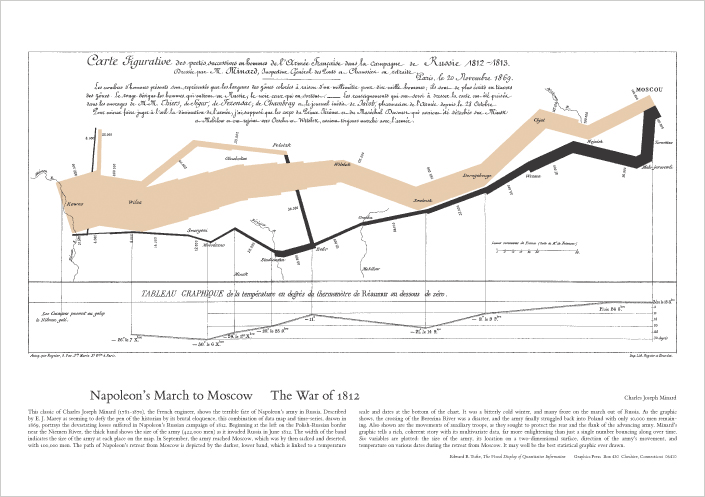 |
| Graphic depiction of the shrinking size of Napoleon's army (width of strip) as it progressed into Moscow and back. From http://www.edwardtufte.com |
Tuesday, April 12, 2011
Upcoming online course: Acceptance Sampling (opens Apr 15)
I will be instructing an online course that can be useful to those working in organizations who receive or send goods to/from multiple sources (the hospital, large shops, Bhutan Agro, UNDP, printers, Yogurt production plant, traditional medicine, BioBhutan, and more).
About the Course:
About the Course:
Monday, November 15, 2010
Kill two birds with one stone
 Got a few minutes to kill online? Here's a great way to increase your knowledge and help end hunger: Freerice.com. For each correct answer, 10 grains of rice are donated through the UN's World Food Programme. Subjects available are English, maths, geography, and more.
Got 10 right answers? 100 grains. 100 answers? 1000 grains. Well, you get the idea! And remember that a cup of uncooked rice contains about 6000 grains.
Wednesday, November 3, 2010
Want to learn how to use the Dzongkha keyboard? DzType is here!
We are glad to announce the launch of DzType, a first-of-its-kind web-based application that aids in teaching the Dzongkha Unicode keyboard.
Learning to type Dzongkha using DzType is fun and easy. As you move from one unit to the next, you learn how to master more keys on the keyboard. By the end, you will be a pro.
The software is free for all. You can run it online or offline (download the package here). Installation is simple and does not require high computing power. Even old and slow computers can be used.

The audience for the tool includes schools (today's students love technology!), colleges, monasteries, and any government, corporate or private organization where individuals can benefit from knowing how to type in Dzongkha.
This is the first project of the Rigsum Centre for Advanced Learning Technologies (CALT), who's mission is to research and develop technologies for advancing education and learning in Bhutan.
Disclosure: The writers of this blog are the directors of CALT (the low rate of blog posts in the last days was due to the DzType launch - we will now resume to our usual blogging rate.)
Learning to type Dzongkha using DzType is fun and easy. As you move from one unit to the next, you learn how to master more keys on the keyboard. By the end, you will be a pro.
The software is free for all. You can run it online or offline (download the package here). Installation is simple and does not require high computing power. Even old and slow computers can be used.

The audience for the tool includes schools (today's students love technology!), colleges, monasteries, and any government, corporate or private organization where individuals can benefit from knowing how to type in Dzongkha.
This is the first project of the Rigsum Centre for Advanced Learning Technologies (CALT), who's mission is to research and develop technologies for advancing education and learning in Bhutan.
Disclosure: The writers of this blog are the directors of CALT (the low rate of blog posts in the last days was due to the DzType launch - we will now resume to our usual blogging rate.)
Thursday, October 7, 2010
Online Dzongkha-English-Dzongkha dictionary

Tuesday, August 24, 2010
Introducing computers into schools
Yesterday's Kuensel editorial discussed the advancement of IT skills in the education systems, mentioning the plan "to empower 5,000 teachers and 50 core group teachers and equip some 168 schools or so with computer labs." The introduction of computers into schools, while now widely implemented in developed countries, has lead to some serious criticism. Does the introduction of computers improve scholastic achievements? Multiple studies have shown that the introduction of computers on its own does not improve, and can even degrade student achievement. Here are a few articles that tell the story:
Kids today quickly learn on their own how to type and to use basic or even advanced applications (have you seen some youngsters on Facebook lately?). The role of teachers (and ideally parents as well) is therefore to introduce students to ways in which computers can enhance their learning and their natural curiosity, as well as to educate them about "life skills" in the Internet age.
Training teachers is not as trivial as teaching them how to use the Microsoft Office package or how to use an Internet browser. Instead, teachers should be introduced to pedagogical methods for enriching their curriculum and academic materials by integrating computer assisted learning. It is not simply the addition of "computer literacy" as a subject, but rather an integration of technology into existing education programs to support developing problem-solving skills, creativity, and independent learning.
- An Israeli prize laureate in education discusses some of the issues with classroom computerization and scholastic achievement in this recent article.
- The 2007 New York Times article "Seeing No Progress, Some School Drop Laptops" describes some of the challenges experienced by schools in the United States that have computers and Internet access.
Kids today quickly learn on their own how to type and to use basic or even advanced applications (have you seen some youngsters on Facebook lately?). The role of teachers (and ideally parents as well) is therefore to introduce students to ways in which computers can enhance their learning and their natural curiosity, as well as to educate them about "life skills" in the Internet age.
Training teachers is not as trivial as teaching them how to use the Microsoft Office package or how to use an Internet browser. Instead, teachers should be introduced to pedagogical methods for enriching their curriculum and academic materials by integrating computer assisted learning. It is not simply the addition of "computer literacy" as a subject, but rather an integration of technology into existing education programs to support developing problem-solving skills, creativity, and independent learning.
Thursday, June 11, 2009
Online Tuition-Free University
What a great initiative: The U.N. has announced the launch of the world's first tuition-free, online university. The university was founded by Shai Reshef, an Israeli entrepreneur. Currently two degrees are available, one in computer science and the other in business administration. There are some minimal fees (e.g., enrollment fees are $10 to $50, depending on the country of origin), but tuition is free. For more information, check the website of UoPeople. To read the official announcement, click here.
Wednesday, April 29, 2009
India Buys 250,000 School Laptops
After the promised "$10 laptop" failed to materialize, the Government of India decided to buy 250,000 XO laptops from One-Laptop-Per-Child. The laptops will be distributed to 1,500 schools. More information about the recent purchase here.
Bureaucrats tend to look for easy solutions to education problems. Throwing money at educational technology is very tempting as it is often seen as a quick fix to the failings of an education system (it also attracts good PR, "we're on the leading edge" etc), but it often fails to deliver the promised results. After all, getting good teachers is a much harder challenge.
Bureaucrats tend to look for easy solutions to education problems. Throwing money at educational technology is very tempting as it is often seen as a quick fix to the failings of an education system (it also attracts good PR, "we're on the leading edge" etc), but it often fails to deliver the promised results. After all, getting good teachers is a much harder challenge.
Subscribe to:
Posts (Atom)